When I think of the best example of a call to action (CTA), I think of my dad, bellowing at me daily to get a job. Eventually, his CTA compelled me to become a productive member of society despite a lifelong belief that work is something to avoid unless absolutely necessary. (Look at me now, Dad!)
Just as personal CTAs can lead to transformative life decisions, marketing CTAs have the potential to significantly impact user engagement and conversion. Here, I’ll share 14 call to action examples, plus tips for writing an effective CTA.
Table of contents:
What is a call to action (CTA)?
A call to action (CTA) is a prompt or message, typically formatted as a button or link, that encourages your audience to take a specific and immediate action.
CTAs are commonly used in marketing and sales contexts to guide users toward the next step in their journey, whether that’s purchasing a product, signing up for a newsletter, or forwarding that chain email to all of their friends to avoid eight years of bad luck. Some common call to action examples include:
-
Sign up
-
Learn more
-
Buy now
-
Add to cart
-
Contact us
-
Download
Types of CTAs
Here’s a primer on some of the most common CTA types.
|
CTA type |
Purpose |
Ideal placement |
CTA example |
|---|---|---|---|
|
Form submission |
Encourages users to fill out a form, providing their information for various purposes |
Contact page, request for quote page, or as part of lead generation forms |
“Get a free quote” |
|
Product or service features |
Directs users to a page or section highlighting the key features of a product or service |
Homepage, product pages, or service descriptions |
“Discover the key features that make our new smartphone stand out” |
|
Social sharing |
Encourages users to share content or products on their social media platforms |
Near the content being shared, such as articles, images, or videos |
“Share this amazing deal on Facebook” |
|
Lead to purchase |
Guides potential customers toward making a purchase after they’ve shown interest or engaged with your content |
Product pages, shopping carts, or as part of drip marketing campaigns |
“Add to cart and enjoy 20% off your first purchase” |
|
Closing the sale |
Used to seal the deal or complete a transaction, often found in the final steps of the checkout process |
Product pages, checkout pages, or limited-time offer banners |
“Limited stock available. Buy now to secure your item!” |
|
Event promotion |
Promotes an upcoming event and encourages users to register or learn more about it |
Event’s landing page, email invitations, or display banners |
“Register for our webinar” |
|
Related content |
Invites users to keep exploring—whether that’s another post on the same topic or more items similar to a product or category page |
End of blog posts, product pages, or inline teasers mid-article |
“Explore more on this topic” |
How to write a call to action
Your CTA should match the page, the audience, and the one action you want. That said, the best CTAs do share some characteristics that you can apply wherever they may be.
1. Give people a reason to act
People click when they can see what’s in it for them, so your CTA should name the payoff upfront—like a discount or a free download. If you’re using a standard link, write the incentive in your CTA’s anchor text (the clickable text).
Here’s where you can borrow from traditional sales techniques by adding urgency with a time limit or bringing up the pain point they’re trying to avoid. That’s how you convince people to click, share, or hand over their email address.
2. Say exactly what happens when they click
People are more receptive to CTAs when they know precisely what to expect, so be transparent about what happens when they click. For example, “Book a 15-minute demo” paints a clear picture of what will happen next, more than “Contact us.”
If visitors are worried about spam, especially if you’re asking for their email, they’re not going to click. This is a good time to gently remind them that you won’t share their information and that you’ll email them only once a week, twice a month, or whatever the case is, to keep their imagination in check.
3. Use command-style, action-first language
CTAs should be strong and unapologetic. That’s not to say you should be rude or demanding (please don’t); there’s a perfect balance between a strong suggestion and a forceful command.
In practical terms, calls to action should start with an actionable verb. This makes the statement sound stronger, and at the same time, clearly communicates what the user should do. If you’re stuck on wording, match the verb to the goal.
|
Goal |
Example CTA phrases |
|---|---|
|
Purchase |
Shop now, Buy now, Add to cart |
|
Sign up |
Sign up free, Get started, Subscribe |
|
Learn more |
Learn more, Read more, See how it works |
|
Download |
Download now, Get the guide, Get the eBook |
|
Contact |
Book a demo, Contact us, Talk to sales |
Likewise, avoid wording that weakens your call to action, including “please” (no matter what Grammarly tells you) and modifiers like “could” and “would.” There’s a time and place for gentle language, but calls to action are not one of them.
4. Make the CTA hard to miss
Strong copy won’t save a button that blends into the page. Here are some ways to treat your CTA so it stands out.
-
Contrasting colors. Use a vibrant color for your CTA, especially against a dull background, so your visitors don’t have to work to find what’s next. While CTAs should stand out, they should still align with your brand’s overall design aesthetic. Consistency in design builds trust.
-
Optimal size. Make the button and text larger than the surrounding elements, but not so large that it overwhelms other content. It should also be easily clickable, especially on mobile devices.
-
Clear typography. Use a legible font that complements your brand. Ensure the text is large enough to read but doesn’t crowd the button.
-
Negative space. Surround your call to action with plenty of negative (empty) space. Setting your CTA apart from the other elements makes it more noticeable and gives it more importance in the eyes of your visitors.
5. Measure and then iterate
Creating your CTA may feel like a lot of guesswork and shooting in the dark—because it is. Testing it is much clearer-cut.
Once your CTA is live, pull up your analytics and compare page traffic to conversions. The percentage of visitors who clicked tells you whether the button needs work or whether you should focus on getting more people to the page in the first place.
While there’s no single benchmark for every industry, many sites land around 5% conversion. If you’re in that ballpark and still missing your goals, try growing traffic before you rewrite the CTA. When conversions fall well below your baseline, A/B test two versions—different phrasing, color, placement, or font—and keep the one your audience actually clicks.
14 call to action examples (and why they work)
Let’s dissect some real-life call to action examples, so you can take what works—strategic copy, design, or placement—to transform your CTAs into clickworthy moments.
Form submission call to action examples
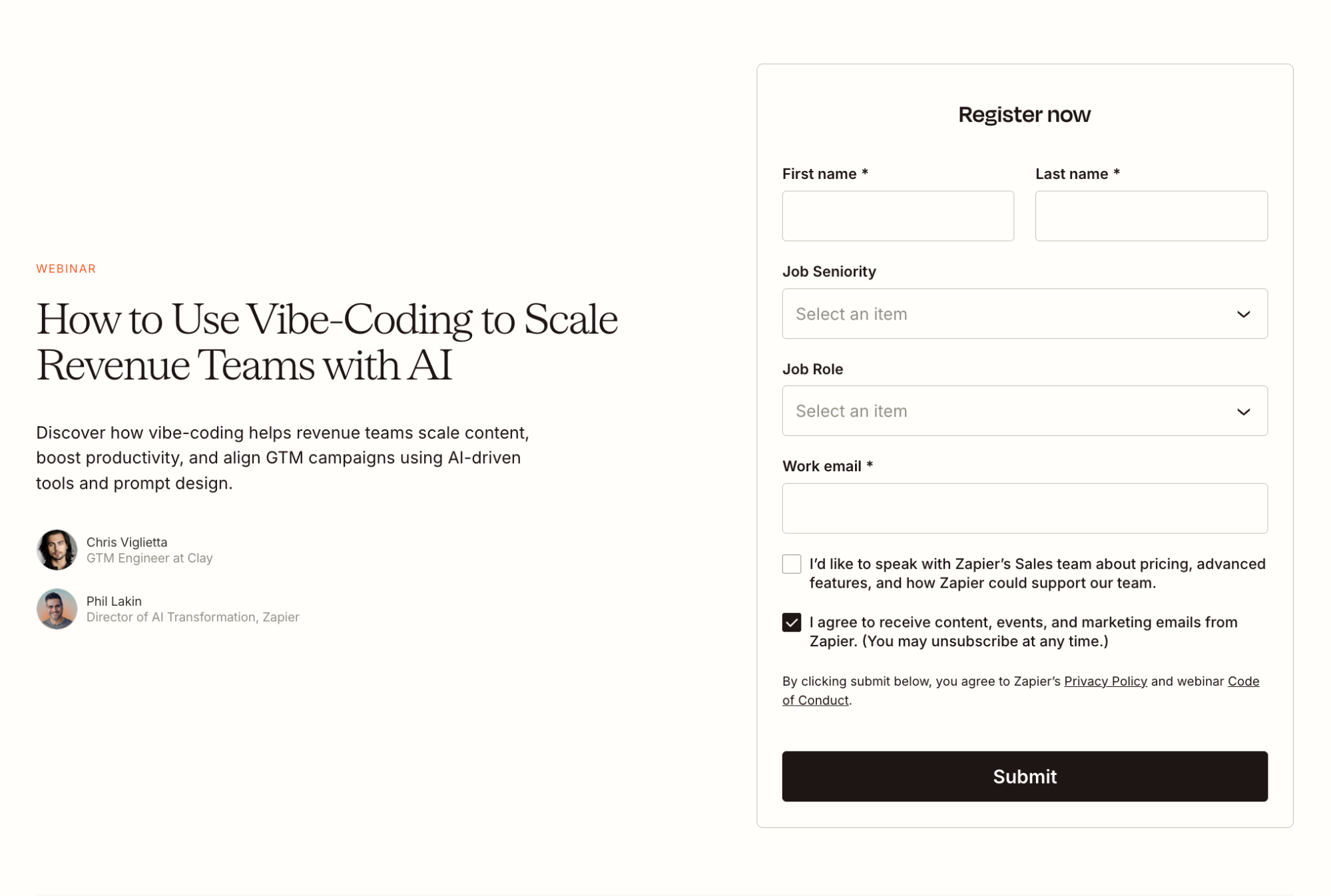
1. Zapier

Why this CTA works:
-
The heading is the real CTA: A generic button like “Submit” works here because the real CTA (“Register now”) sits at the top of the form. By the time you’ve filled in your details, “Submit” just confirms what you already committed to.
-
One optional ask, no pressure: The form includes an option to chat with Zapier’s Sales team about pricing. It’s clearly optional and easy to skip. But for anyone curious, the webinar registration doubles as a low-key sales pipeline moment without making the form feel like a trap.
2. Starface

Why this CTA works:
-
Playful CTA, serious ask: Pairing the ask (your phone number) with a playful CTA (“blast off!”) that leans into the brand’s voice makes it feel less like a data grab and more like opting into something you’d actually want texts about.
-
The pop-up body closes the gap: The vague CTA works only because the copy above it does the real explaining: you’re joining an SMS list for exclusive discounts and early access to product drops. By the time you reach the CTA, you already know what you’re trading your number for.
Product or service features call to action examples
3. Try Galaxy

-
Echoes the headline: On Try Galaxy, the hero says “Try Galaxy on your phone”; the primary CTA shortens it to “Try now!” and a second CTA at the bottom brings back “Try on your phone.” Each label is slightly different, but they all start with the same verb, making every click feel like it’s picking up where the headline left off.
-
Preview before you tap: Between those two CTAs, an interactive, visual grid lets you tap into a sneak peek of Try Galaxy’s different features, so you can get a product demo with no strings attached.
4. Notion

Why this CTA works:
-
Feature-specific CTA: “Try AI Meeting Notes now” names the exact tool that clicking the CTA will take you to.
-
Two ways in after the button: Below the CTA, there’s an inline instruction (“type
/meeton a Notion page”) and a P.S. with a demo link. That’s three ways to engage, at three different levels of commitment: try now, try it in your next meeting, or watch a demo first.
Social sharing call to action examples
5. Letterboxd

Why this CTA works:
-
Channel-specific sharing: Click “Share” on any Letterboxd film page, and you get a shortened URL to share—each one set up for a different social channel. For example, Facebook opens a draft post with the poster, title, and Letterboxd link already loaded. You’re not pasting a bare link and hoping the preview figures itself out.
-
Strategic placement: The “Share” CTA sits in the sidebar next to the synopsis, with the ratings block directly underneath. You’re reading the plot and clocking that 3.8-star average in the same column as the share icons—which is exactly when opening Facebook to tell your friends that that’s, frankly, a crime starts to feel reasonable.
6. Spotify

Why this CTA works:
-
Built to be shared: Every December, millions of people post their top artists, listening age, and minutes streamed without stopping to think, “Wait, how does Spotify know all this?” Instead, seeing someone else’s Spotify Wrapped makes you want to run to the app so you can share yours, too. “Share this story” is the CTA that closes that loop—and it’s specific enough to tell you you’re posting a polished, story-sized graphic, not a screenshot of a spreadsheet or your mom’s cat contemplating life.
Lead to purchase call to action examples
7. Zapier

Why this CTA works:
-
The page earns the click: Zapier’s homepage subheadline spells out what you’re actually getting—guardrails, model controls, visibility—before “Start free” appears, so the CTA shows up after the case has already been made, not before it.
-
The stats quietly create social pressure: By the time you’ve clocked the stats—450K+ agents built, 9,000+ integrations, 3.39M+ MCP tool calls—you’re wondering what you’ve been missing. “Start free” lands as the answer to that question, not a pitch.
8. NYT Games

Why this CTA works:
-
Price in the CTA: Most subscription ads hide the cost until checkout. NYT Games puts “$3 (CDN)/MONTH” directly in the in-ad CTA. This way, the one thing most likely to make you hesitate is out of the way before you tap.
-
Gameplay before the pitch: The ad shows a Connections puzzle mid-solve before asking for anything, so you’re deciding whether you like the product while you’re still watching the ad. By the time “Subscribe” appears at the bottom, you’ve already had a few seconds of the actual experience.
9. Wealthsimple

Why this CTA works:
-
Two CTAs for two kinds of ready: Wealthsimple’s business page pairs two CTAs side by side—”Open a business account” and “Talk to our team”—so if you’re sold, you can move; if you’re not, you have somewhere to go that isn’t just leaving the page.
-
Primary CTA in the header and hero: “Open a business account” appears in both the sticky header and the hero before you’ve scrolled anywhere. For a financial product where the headline is just one word (“Business”), the CTAs have to carry the pitch, and putting the primary one in two places means it’s always in view.
Closing the sale call to action examples
10. AllTrails

Why this CTA works:
-
Strikethrough does the selling: By the time the CTA (“Get offer”) appears, the price anchoring (original price crossed out above the discounted price) makes the decision feel obvious. The button barely has to try.
-
Framing the CTA as a claim, not a commitment: The CTA frames the tap as snagging a deal versus signing up for a recurring charge, making it that much more enticing.
11. AG1

Why this CTA works:
-
The discount arrives pre-earned: “You’ve Got 20% Off your first subscription order” frames the deal as something you’re already holding before you’ve agreed to anything. Clicking through feels like following through, which is a much easier psychological move than deciding to buy.
-
A quiz instead of a close: You’ve been on the homepage long enough to seem interested, so AG1 surfaces a pop-up—and instead of a buy button, it asks “What’s your top health focus?” The purchase is still happening, but turning the close into a personalization question makes it feel like the brand is meeting you where you are, not rushing you out of consideration.
Event promotion call to action examples
12. Apple

Why this CTA works:
-
The CTA assumes you’re going: The CTA (“Add to calendar”) skips the decision step entirely. Most event CTAs leave room for people who are still deciding—for example, “Learn more,” or “Register.” This one presupposes you’re in, so the only thing left is making it official on your calendar.
-
Low-ask CTA: Clicking the CTA to add the event to your calendar is a smaller ask than a typical event registration, which is what makes it work—especially for something people are already looking forward to, which is usually the case with any Apple event.
13. Canva Create

Why this CTA works:
-
Agenda-first, ticket-second: This event email from Canva lets you build your agenda prior to buying a ticket. By the time you’ve built your agenda and gotten excited for what your day could look like, buying a ticket becomes the natural next step.
-
Friend-text urgency: Pairing “There’s only a few tickets left” with a casual CTA (“Ok, I’m in”) makes the scarcity messaging land. The overall messaging feels less like a pressure tactic and more like a friend giving you a heads-up to snag tickets before they’re gone.
Related content call to action examples
14. Zapier

Why this CTA works:
-
Perfectly timed related link: In this Zapier article about the best HubSpot alternatives, the bolded “Learn more:” label treats the link (“Pipedrive vs. HubSpot”) like a natural part of the content. It reads less like a recommendation and more like the article continuing the thought.
Call to action FAQ
Or, as they say in the biz, “CTA FAQ.” Because there’s no such thing as too many three-letter acronyms. L-O-L.
Why are CTAs important in marketing?
Calls to action provide your audience with a clear sense of direction, guiding them toward specific actions like making a purchase, signing up for a newsletter, or downloading a resource. They tap into the Action > Reward system that our brains thrive on, offering satisfaction—like pressing an elevator button. This inherent desire for interaction can be leveraged by crafting compelling CTAs that prompt users to engage further.
What makes a call to action effective?
The effectiveness of a CTA depends on its copy, design, placement, and relevance to the user. For example, depending on your audience, the phrase “Snag your copy” might resonate with a larger group than something more generic, like “Download now.” Or, if someone visiting your eCommerce store is a first-time browser, they’re likely not ready to click “Buy now.” But they might be curious enough to click “Learn more.”
Identify which action(s) will bring the most value to your business, then use your CTA to steer users in the right direction.
Where should I place my CTAs on my website?
Place your CTAs where they’ll catch the attention of viewers on your website. Key locations include the top of landing pages, within the middle of content, or at the end of blog posts. Use contrasting colors and surround them with negative space to make them stand out. This will help encourage viewers to click.
How can I test the effectiveness of my CTAs?
One way to test CTA effectiveness is to use A/B testing with different designs or wording. Take two versions of your CTA and pit them against each other to see which one gets more clicks. Set a time limit and monitor performance over that time to see which performs better. You can also do this by comparing other types of campaigns or tracking conversion rates against benchmarks.
Related reading:
This article was originally published in November 2023 by Abigail Sims. The most recent update, with contributions from Jessica Lau, was in June 2026.


